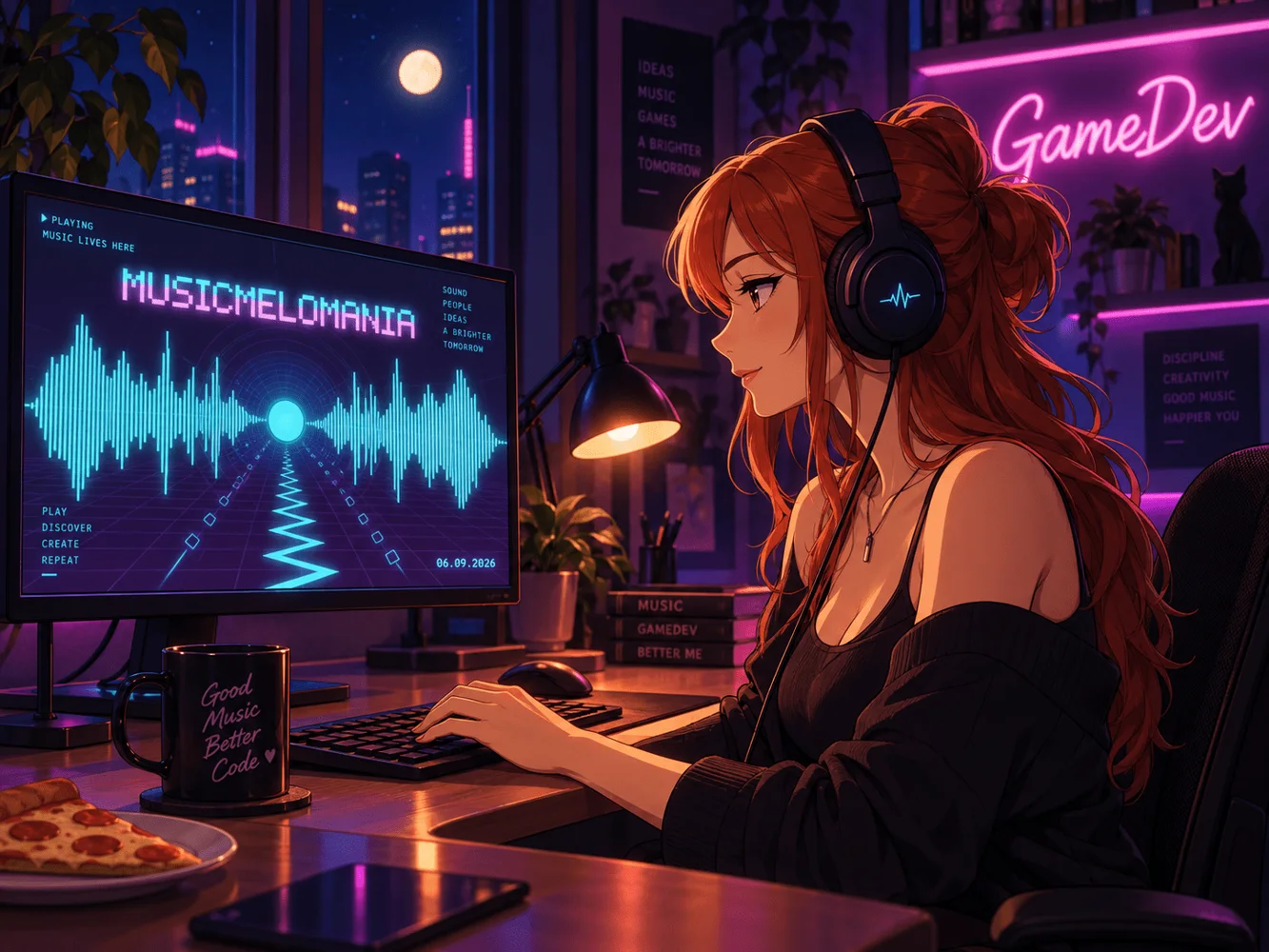
I'm making MUSIMELOMANIA, a mix of Vampire Survivors, Brotato and Audiosurf.
The idea is to play through your playlist as a roguelike. Each song becomes an arena. Weapons fire to the music, while enemies and effects react to different aspects of the track.
What the run was missing
I'd settled on this run structure:
- Build a playlist from analysed tracks and play roughly ten battles with different conditions and modifiers. If there are fewer than ten tracks, they repeat. You can use the same song for the entire run if that's your thing.
- Visit a shop between battles. Spend crystals earned in combat on stats, weapons or a random roll.
- Seven musical aspects, seven weapon slots.
- Basic character stats.
- Basic weapon combinations. For example, a wave plus chain lightning becomes chain lightning that sends out a wave from each target.
This is roughly what it looked like.
Playing it myself, I realised the system felt flat. Weapons fired and stats went up, but there was no satisfying discovery and very little actual buildcrafting.
That sent me back to the drawing board.
From orbs to a deck
Progression needed depth and a clearer purpose. I also wanted the player to have more say in how a weapon fired, since during combat their main job was simply to move.
That led to orb upgrades.
Here's the idea:
You start with a basic weapon that fires balls to a musical aspect. As you upgrade it, you choose the projectile's form, elemental effects and behaviour. Upgrades cost currency earned in combat. By the end of a run, you'd have about two heavily upgraded weapons cutting through the crowd.
For example:
- A beam that bounces between enemies and freezes them.
- Chain lightning with lots of targets that sets enemies on fire.
- Merge an upgraded weapon with another one to combine some of their effects.
For a while, I really liked this idea. I even rebuilt some of the mechanics around it.
But balancing and assembling all those combinations was a pain. I also started to doubt whether that much complexity would be enjoyable in a game meant for chilling out with music.
After more thinking, I arrived at something that felt simpler and more interesting.
The deck takes shape
Why overload the player? Give them weapons, effects and activation conditions, then let them combine those pieces. The trick is that you discover them gradually. Finding a new card should make you think: 'Hang on, what if I combine this with that?'
After trying a few versions, I settled on this approach:
- Seven slots for weapon cards.
- Eighteen slots for effect cards.
- One slot for a super ability card.
- Effect cards activate under a condition or after a certain point in the song. Some can be attached to weapons.
- Weapons work from the start of the battle.
- Cards also give stats. The idea was to trade stronger effects for weaker stats, and weaker effects for stronger stats.
- Build your starting loadout from a collection of unlocked cards.
- After winning a battle, pick one of three cards. An unfamiliar card is marked as found in the collection.
- To unlock a card permanently, buy it with metacurrency in the collection, or spend saved crystals after defeating a boss.
- Fifteen route nodes: ten regular battles, one boss and four shops. Shops add cards to the current deck and help you discover new ones for the collection.
- Each card contributes to a threat meter, which affects enemy types, spawn counts, health, damage and speed.
So now it was becoming a bit of a deckbuilder.
The collection.
Putting a build together.
And a late-game battle.
Next steps
What's next?
- Finish some of the rough edges.
- Polish combat. It's still a little chaotic, but this version finally feels like something I want to keep playing.
- A Steam page.
- A demo.
- Feedback from players.
- Keep bringing it into shape.
- And try to release it.
That's where the game stands for now. I'd love to hear what you think, even if it isn't your thing. Thanks for reading.