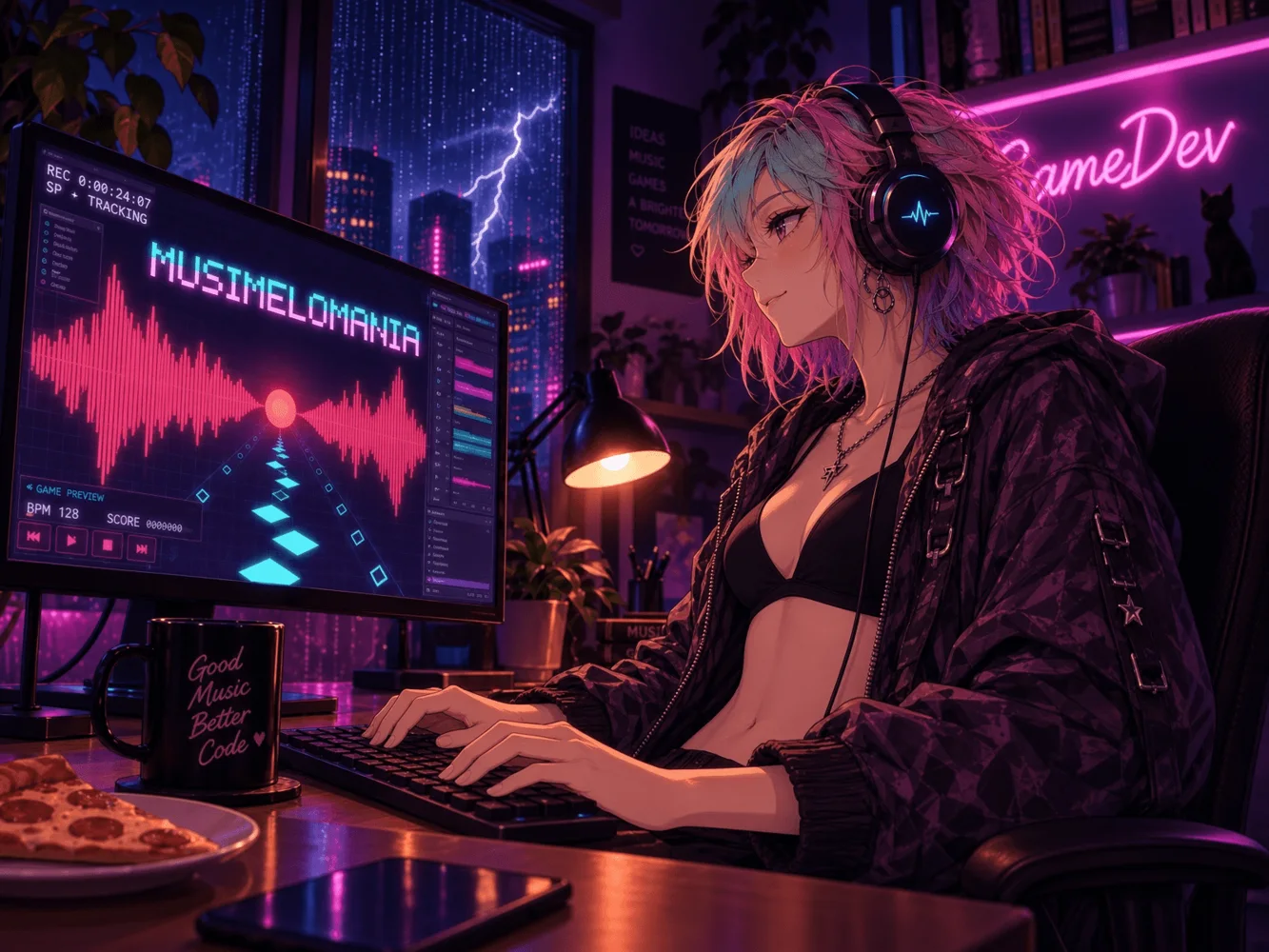
Hi! I'm still working on MUSIMELOMANIA. It's been three weeks since the last update. I've reworked enemies, weapons, abilities, menus and a bunch of other things, so here's a look at the progress.
If this is your first look: it's a mix of Vampire Survivors, Brotato and Audiosurf, played to your own music. Load your songs, assemble cards and run around an arena trying to stay alive. Collect cards and earn metacurrency to customize the visuals.
How a run works
In a run, you build a playlist from your own music and follow a route map. One battle lasts one song. Between battles, choose the next stop: rewards, new cards, a shop, a special event or a fight with an extra condition. Cards join your collection as you play, giving you more options for future builds. At the end of the stage there's a boss. So far, one is ready.
Free mode lets you play a particular song for a score. I'd like to add shared leaderboards eventually, along the lines of Beat Saber. For now, you choose music, adjust your build and threat level, and try to finish with a good result. It's a place to test an absurd card combination and see how well you can dodge to a favourite song.
The route has special nodes too. In Hunt, a Hunter appears one third of the way through the song and starts chasing you. The cassette Terminator is on duty.

I also rebuilt the main menu because it wasn't explaining much. Hover over Run and the TV shows the whole process: playlist, cards, route, battle and rewards. Free mode has its own preview with a build and a score screen. That makes the basic idea easier to understand before you start.
Aspects, the timeline and connections
A track has musical aspects: drums, bass, melody, vocals and other markers. Put a weapon on an aspect and it attacks when an event occurs there. Ring Wave on drums, for example, sends out waves with the percussion. Move it to another aspect and its attack rhythm changes. Since these aspects come from analysing the selected song, the same build behaves differently to different music.
Non-weapon cards sit along a timeline. Six starting slots activate immediately. After that, the further along a card is placed, the later it joins the battle. Keep something useful at the start, or save something wild for the build-up. Some cards have their own trigger conditions, such as a chorus or the very end of a song.
Connections link to a particular weapon with a cable and change its attacks. The cable is there because I liked how it looks. A super ability has its own slot, and you must choose one before combat.
You can rearrange the setup: weapons occupy aspect slots, effects follow the timeline and connections link to weapons. A new song is a good excuse to put the whole thing together differently.
Cards and patrons
Patrons are new. I'm still unsure about them, but wanted a way to shake up the initial cards and conditions. Choose one before starting and it adds its own modifiers for the whole run. We'll see how that develops.
Then and now
For the comparison I used a battle to Alex Peipman's No Remorse from Machine Party. A moving divider lets you compare both versions at the same moment in the song. The card on the right shows what's triggering.
Weapons and your own style
I redrew the weapons too. Lightning has its own patterns, waves have a clearer front, and rockets and other projectiles have distinct shapes and trails. You can see those changes together in the battle comparison.
When everything explodes at once, it's easy to miss an individual effect. In this demonstration, only the featured card keeps its colour while everything else is dimmed. It gives a clearer look at the kinds of cards and abilities in the game.
Personalization lets you try visual styles and watch them in motion immediately. Glass waves, cassette charges, glitch lightning. Or make everything pink, if that's your thing. Stage on Fire is one example: both the way charges form and the explosion itself change with its style.
I wanted to show the new arenas together with weapons, rather than as a pile of still images.
Enemies and the boss
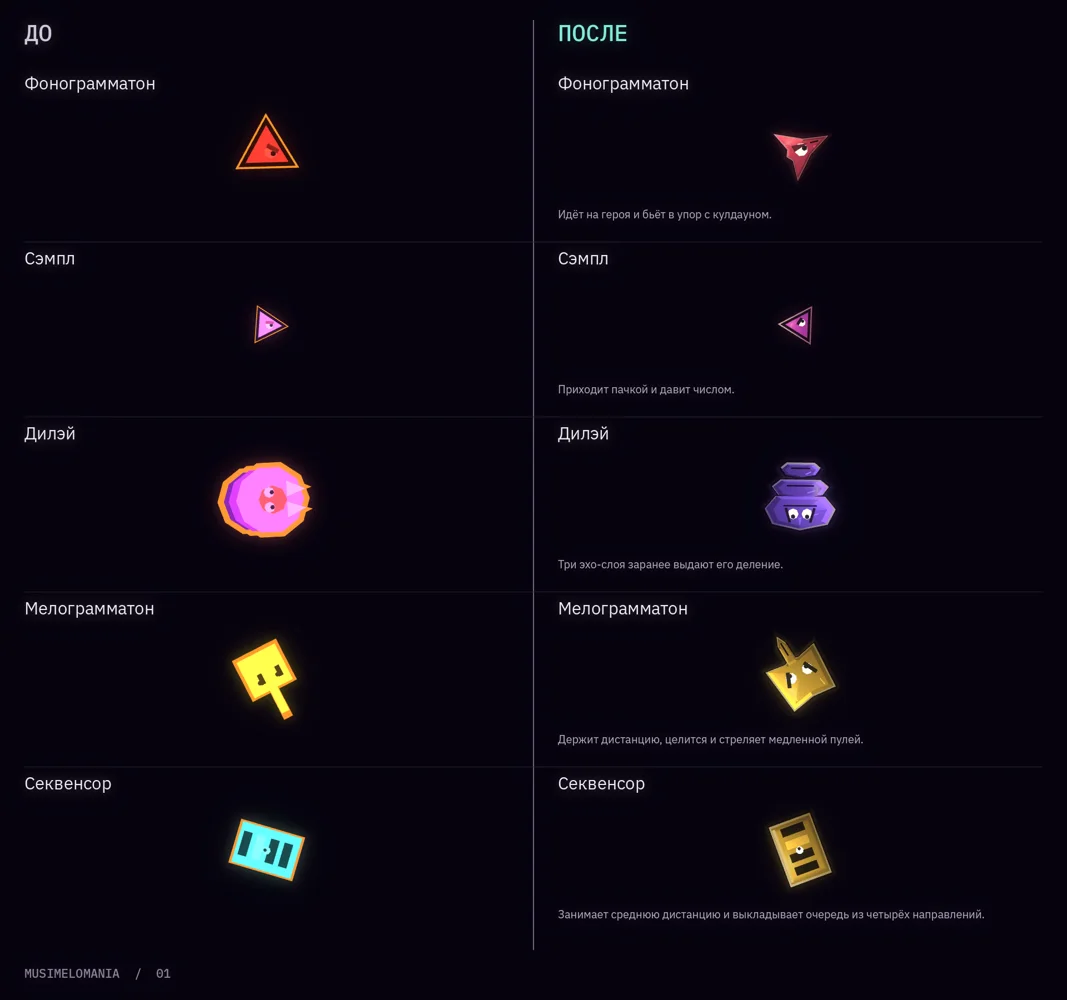
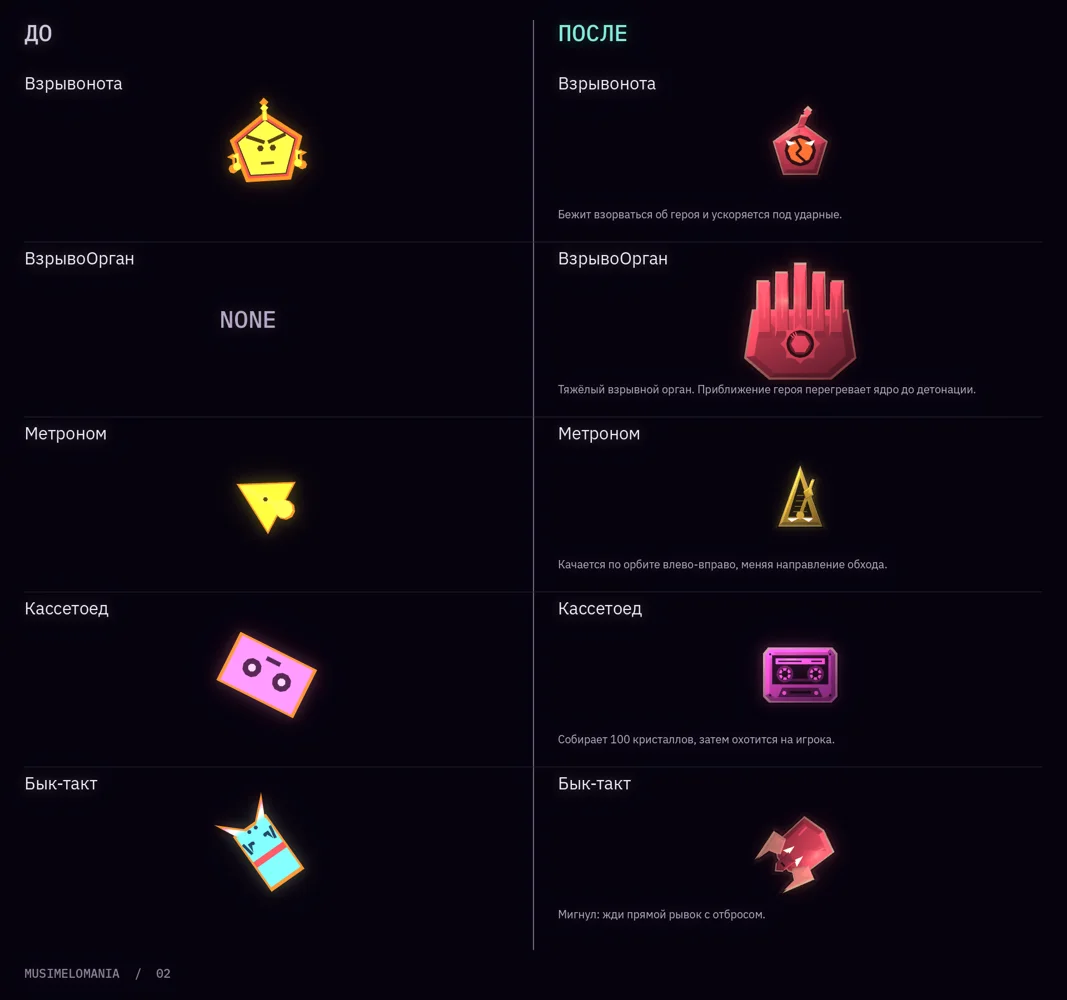
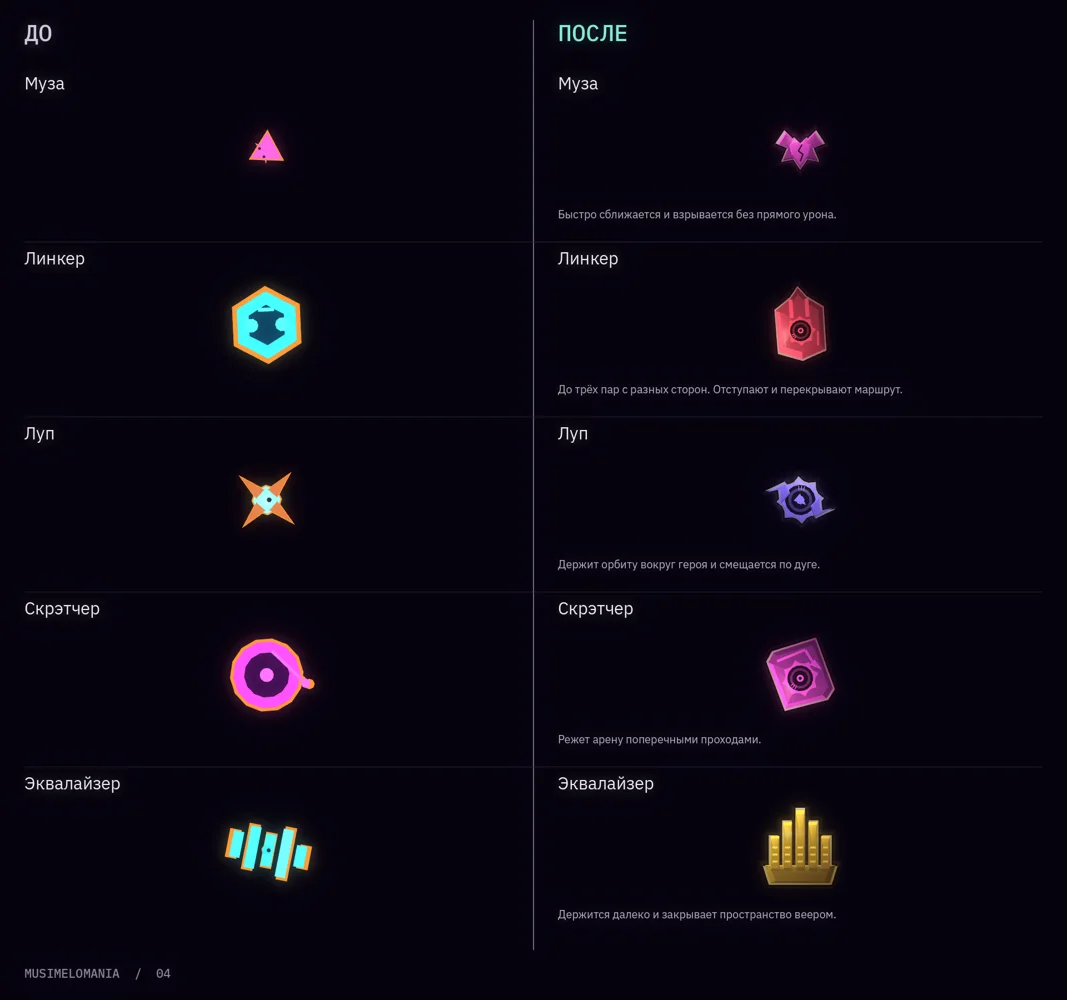
Enemies now differ in more than colour. Here they are in bestiary order, starting with the lowliest ones. I came up with their names after rather too much Jägermeister.

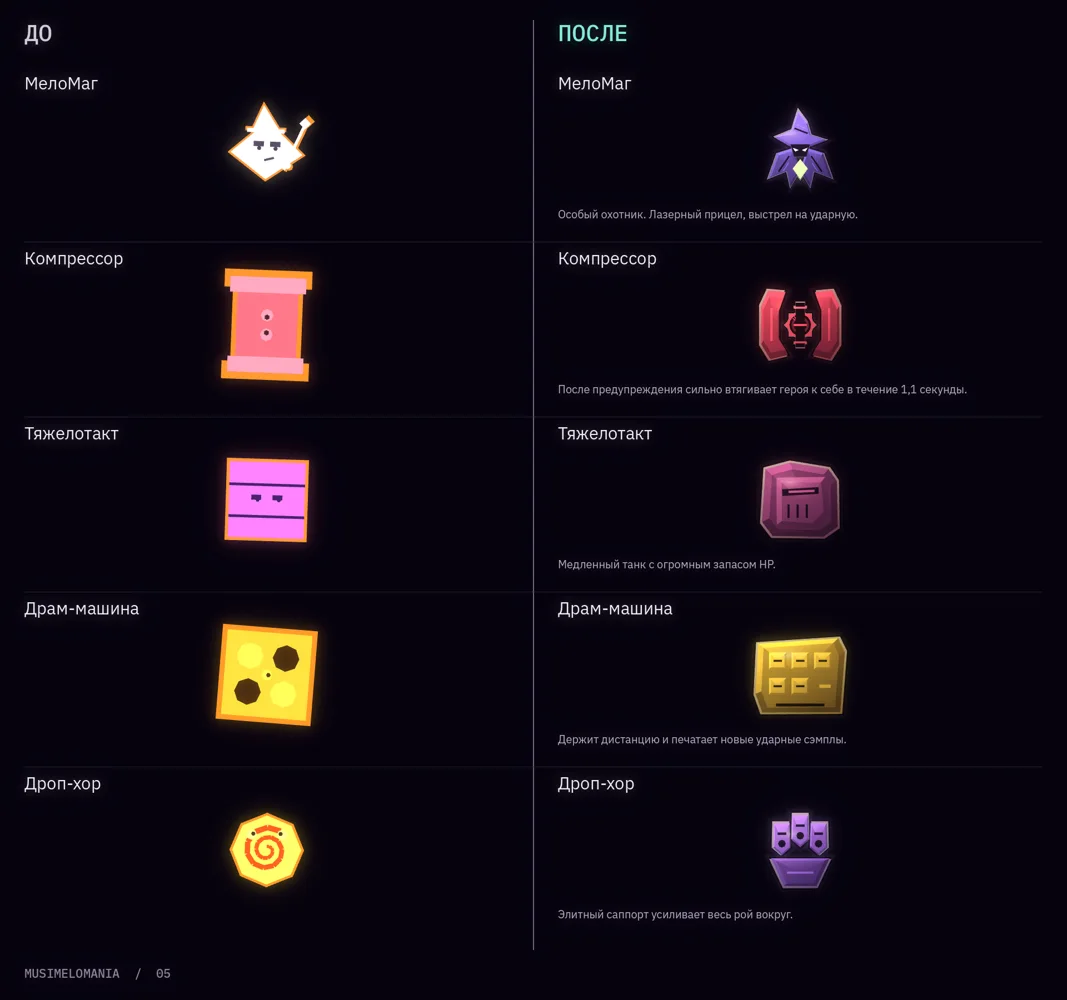
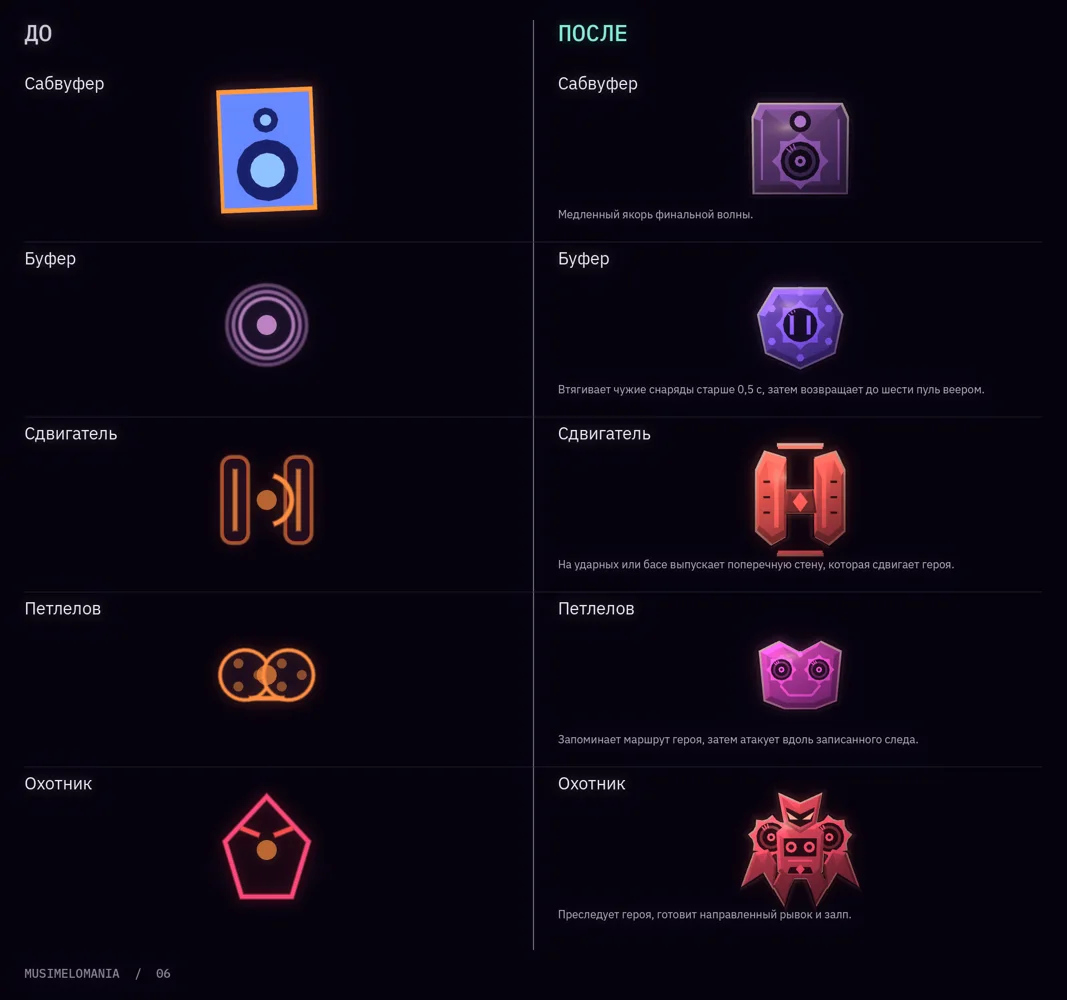

The boss
DJ 001, the Mixing Desk, waits at the final node of the first stage. It's the only finished boss so far. Four more are in progress, but aren't ready to show properly yet.
Its appearance isn't final either. Like everything else, it attacks to the music.
The HUD and resurrection
The combat interface has changed too. Health, super ability readiness and active effects are easier to find, especially when half the deck is going off at once.

Regular resurrection has a new look: the character comes apart, then assembles again.
The collection and what comes next
You can browse all the weapons, connections, events, effects and super abilities here. I've tried to make cards easier to read at a glance: a short description on the card, details when you open it.
Next I want to finish more encounters and bosses, keep working on the route and see what builds people come up with using their own playlists. That's how I'll find out how fun it really is. Nearly six months in, I'm surprised I still haven't got sick of making it. Thanks for reading, and let me know what you think.